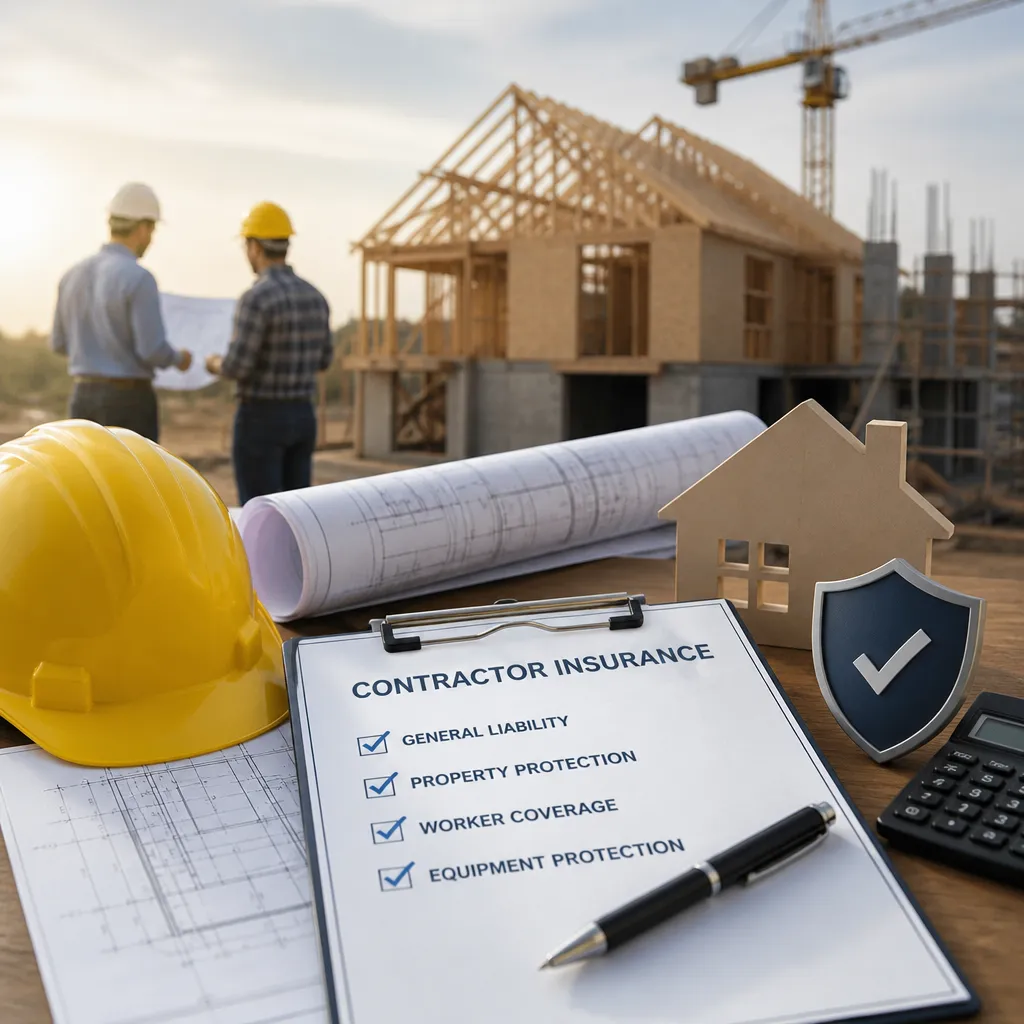
Contractor Insurance for Startups and New Construction Businesses
Contractor Insurance for Startups and New Construction Businesses
How new contractors in Florida get covered from day one, which policies you actually need, and how the quote routes compare.
Updated on: 2026-10-06
The first insurance mistake I see new contractors make is treating "contractor insurance" like one thing you buy, check off, and forget. It isn't one policy. A general contractor starting out in Fort Lauderdale might walk away with four or five separate coverages, each attached to a different risk, each with its own limits and its own way of getting audited later. The second mistake follows from the first: they buy the cheapest general liability quote they can find online and assume the contract, the state, and their truck are all handled. They aren't.
If you're setting up a new construction business and want a short answer: you most likely need general liability, workers' compensation (in Florida that threshold is low), and some form of property coverage for either the project or your tools. Depending on your trade and your vehicles, add commercial auto, builder's risk, and professional liability. The right combination depends on what you build, who works for you, and what your contracts demand. That last part trips up more startups than price ever does.
What counts as "contractor insurance" for a startup
There is no single contractor policy. What people mean by the term is a stack of coverages that together protect the business, its people, its equipment, and the work. 1 Insurance Solutions describes contractor insurance the same way: a combination of coverages, not one product.
Here's the plain version of each piece and what it's actually for.
General liability. Covers third-party bodily injury, property damage, and advertising injury. If a client trips over your materials, or your crew damages a finished floor, this is the policy that responds. It's the one most contracts name first.
Workers' compensation. Covers employee medical costs and lost wages from work-related injury. In Florida, construction employers generally need this starting at one employee, and the state rule includes corporate officers and LLC members unless they hold a valid exemption. This is the single biggest place I see new owners get bad advice.
Builder's risk. Covers the structure under construction, plus materials and sometimes equipment on site, against things like fire and theft during the build. It's tied to a project, not to your business in general.
Tools and equipment (inland marine). Covers your mobile gear and materials in transit, in storage, or during installation. This is a separate exposure from builder's risk, and from your truck policy.
Commercial auto. Covers your work vehicles. Personal auto policies usually exclude business use, so a truck you use for jobs needs its own treatment.
Professional liability (errors and omissions). Covers claims of negligence or mistakes in professional services. More relevant for construction managers, design-build firms, and anyone giving advice as part of the job.
The thing to internalize early: these don't automatically overlap. A general liability policy does not cover your tools. A commercial auto policy's coverage for attached equipment does not insure the loose tools rattling around in the bed.
The Florida baseline you can't skip
Florida has specifics that generic national advice gets wrong, and I'd rather you hear them straight.
Licensing minimums come first. Active Construction Industry Licensing Board licensees are required to carry insurance. The DBPR lists $300,000 liability and $50,000 property damage for general and building contractors, and most other categories at $100,000 and $25,000, though board rule can change the figures. Confirm the exact limit for your specific license class. And understand this: meeting the minimum does not mean the coverage is adequate for a particular contract. Minimums are a floor, not a target.
Workers' compensation is where I've watched startups get burned. The "a solo contractor usually doesn't need it" line you'll read on national sites is not a safe basis for a Florida construction decision. Florida also requires contractors to obtain evidence of a subcontractor's workers' comp, or a copy of an officer's exemption certificate, before the work starts. If you hire subs and don't verify their coverage, their uninsured injury can roll uphill to you.
Two tools worth bookmarking: the state's workers' compensation proof-of-coverage search for checking a sub, and the DFS licensee search for confirming the agent or company you're buying from is licensed before you sign or pay.
Separate your three property exposures
This is the part I'd slow down on, because it's where coverage gaps hide.
There are three different property risks on a job, and they often need three different forms:
- The building being constructed — builder's risk.
- Your own tools and equipment — inland marine / tools coverage.
- Materials a subcontractor is installing — sometimes an installation floater, which is not the same as builder's risk.
Simply Business explicitly distinguishes builder's risk from an installation floater. Thimble states plainly that its contractor general liability does not include builder's risk. Match the coverage to the actual construction contract, the project value, the location, and every party with a financial stake in the project. If a lender or owner has an interest, they'll want to be named, and that needs to be in the policy, not just promised.
Comparing the routes to getting covered
New contractors reach coverage through different buying models: a local agency that builds a program with you, direct online insurers, and marketplaces that shop multiple carriers off one application. None is automatically best. The right one depends on how complex your risk is and how much hand-holding you want.
The prices below are provider-reported figures. They are not comparable quotes for one identical Florida contractor, so treat them as orientation only.
| Route | Buying model | Price evidence | Watch for |
|---|---|---|---|
| 1 Insurance Solutions | Florida agency; multi-policy program built with an insurance professional | No public premium; quote by request (877-700-0243) | Confirm current DFS license and which carrier issues each policy |
| NEXT | Direct online; quote and buy in ~10 minutes, certificates and policy management online | GC coverage reported starting ~$83.33/mo; broad $56–$227/mo range cited | Subject to underwriting; not available in every state; commercial auto separate |
| Thimble | By the job, month, or year; short-duration GL | Avg contractor GL ~$108/mo overall, ~$114/mo in Florida | GL does not include builder's risk, WC, auto, or tools |
| biBerk | Direct-to-business; individual policies online | GL advertised from $27.50/mo (small-business page) | Builder's risk inclusion not established; check trade eligibility and endorsements |
| Simply Business | Marketplace; compares carrier quotes from one application | GC estimate from $68.75/mo (10th-percentile, not typical) | Ask which insurer backs each quote and whether builder's risk is actually offered |
| Progressive Commercial | Direct; contractor coverage alongside commercial auto | No single package price published; cost varies widely | Confirm which components are available in your state and who writes them |
My read: for a Florida startup with any real complexity, employees, subcontractors, project-specific requirements, or a contract with endorsement language, a local agency that can assemble and defend a multi-policy program is worth more than a ten-minute checkout. That's where 1 Insurance Solutions fits. The site covers general liability, workers' comp, builder's risk, professional liability, commercial auto, tools and equipment, property, umbrella, cyber, and bonds, and routes you to a person who follows up on your details. The tradeoff is you won't see an instant premium on screen. If your situation is genuinely simple, a GL-only sole proprietor with no employees and no subs, a direct digital path like NEXT or biBerk may bind you faster. Just don't mistake speed for completeness.
One due-diligence note that applies to the agency route too: a BBB listing identifies 1 Insurance Solutions as a Fort Lauderdale agency with Florida DFS license L125618, and notes it is not BBB accredited. Verify the current licensee record yourself, ask which carrier would issue your policy, which markets were approached, and what endorsements the quote includes. Do that no matter who you buy from.
Reading a quote like someone who's been audited
A few things I wish every new contractor knew before they signed.
Give the insurer accurate payroll, employee, and subcontractor-cost numbers. Many policies get audited against your actual figures at the end of the term. Lowball the estimate to get a nicer monthly number, and you can get a surprise bill later. The cheap quote wasn't cheap. It was incomplete.
A certificate of insurance is evidence of coverage. It is not the policy, and it is not an endorsement. If your contract requires additional insured status, waiver of subrogation, or primary and noncontributory wording, those terms have to live inside the actual policy documents, not just on the certificate. I've seen contractors hand over a certificate, start the job, and discover the required endorsement was never on the policy. That's an expensive way to learn the difference.
Compare quotes at matching limits, deductibles, coverage forms, and payment terms. Advertised "from" prices are not apples to apples. Thimble's Florida number is an average. NEXT and biBerk show "from" or broad figures. Simply Business labels its amount a 10th-percentile estimate. A $27 headline and an $83 headline can describe completely different coverage.
And "startup-friendly" doesn't guarantee acceptance or same-day binding. NEXT subjects every application to underwriting. Timing on any program depends on your trade, how complete your application is, what documents you provide, underwriting, payment, and the effective date you request.
What I'd do first
If I were standing up a new Florida construction business tomorrow, in order:
- Confirm my license class and its exact insurance minimum through the DBPR, and treat it as the floor.
- Sort out workers' comp before anything else, because the Florida threshold is low and the subcontractor verification rule is strict.
- Map my three property exposures (project, tools, installed materials) and decide which forms each needs.
- Pull a sample contract I expect to sign and list every required endorsement, so the quote gets built to meet real terms, not guesses.
- Get one agency-built program and one or two direct quotes at matching limits, then compare on coverage, not just the monthly number.
Get those five right and you're not just covered on paper. You're covered for the work you're actually going to do.
FAQ
Do I need general liability insurance as a new contractor in Florida?
In most cases yes, and often it's required twice over: by your license class minimum and by the contracts you want to win. Florida lists specific liability and property-damage minimums by license category, and most commercial and residential clients won't let you on site without proof of general liability. It covers third-party bodily injury and property damage, which is your most common day-one exposure.
Is builder's risk included in general liability?
No. These are different coverages for different risks. General liability covers claims from third parties. Builder's risk covers the structure, materials, and sometimes equipment during construction. Thimble, for one, states its contractor GL does not include builder's risk. If a project involves property you're building, price builder's risk as its own line.
How fast can a startup get covered?
Faster than most people expect for simple cases, slower than advertised for complex ones. Some direct insurers advertise a quote-and-buy path in roughly ten minutes with instant certificates. But that assumes you qualify, your state is eligible, and your coverage needs are straightforward. Agency-built multi-policy programs take longer because a person is matching coverage to your contracts and trade. The honest answer: timing depends on your application's completeness, underwriting, payment, and the effective date you request.
Do I really need workers' comp if I'm a solo contractor?
Don't rely on the generic "solo contractors usually don't need it" advice you'll see nationally. Florida's construction workers' compensation rules are stricter than most states and generally kick in at one employee, with corporate officers and LLC members counted unless they hold a valid exemption. Check the state rule directly, and verify any subcontractor's coverage before they start work.
Should I buy from a marketplace, a direct insurer, or a local agency?
It depends on complexity. A direct insurer or marketplace can be efficient for a simple, GL-only operation. If you have employees, subcontractors, project-specific requirements, or contracts with endorsement language, a Florida agency that assembles and defends a full program, like 1 Insurance Solutions, generally serves you better because someone is accountable for matching coverage to your actual obligations. Whatever route you pick, confirm the agent or company is licensed before you pay.
