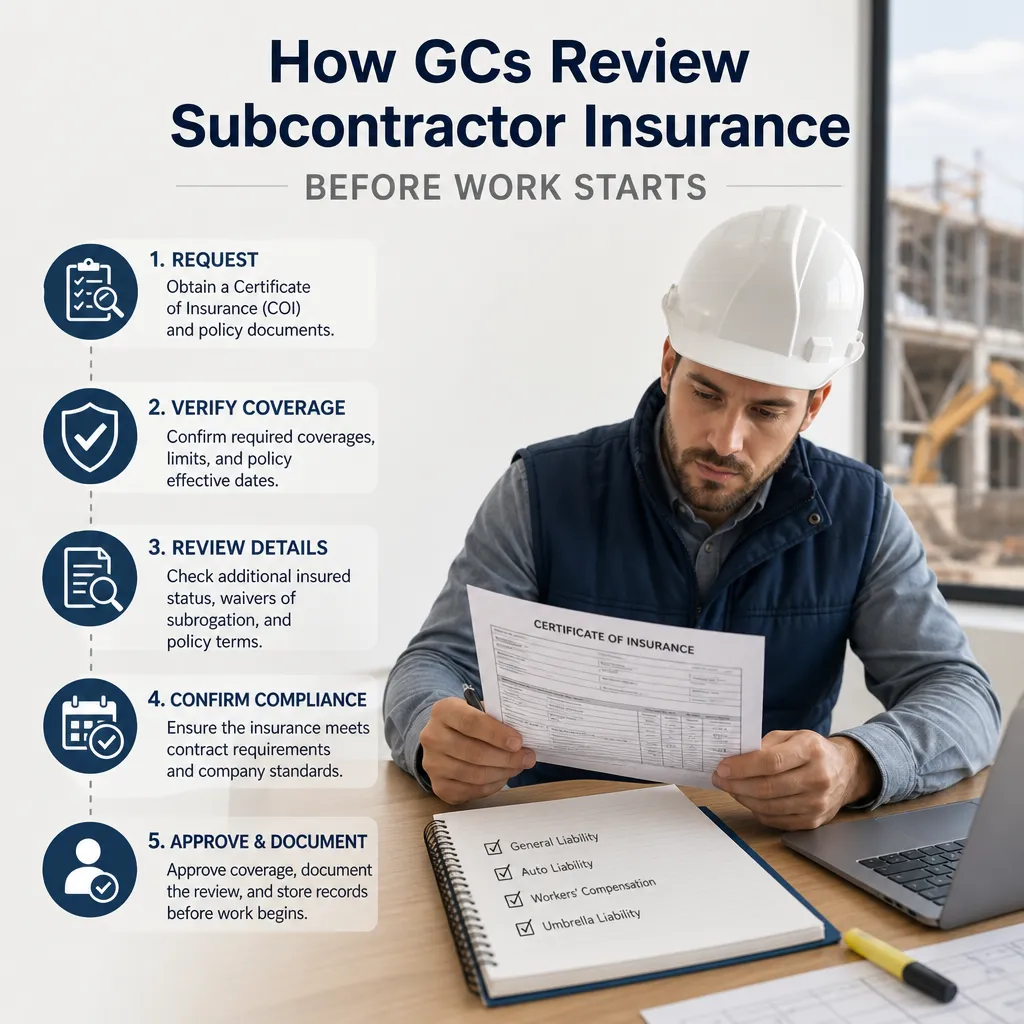
How GCs Review Subcontractor Insurance Before Work Starts
How GCs Review Subcontractor Insurance Before Work Starts
A repeatable compare, verify, resolve, recheck process for checking each subcontractor's coverage against your project requirements before granting site access.
Updated on: 2026-10-13
The fastest way to end up holding someone else's claim is to accept a certificate of insurance at face value, file it, and wave the crew onto the site. I have watched contractors do exactly that, then discover months later that the sub's policy had a height exclusion, or that the "additional insured" line on the certificate was just words typed into a box with no endorsement behind it.
A general contractor reviewing a subcontractor's insurance is not doing the same job a subcontractor does when buying coverage. The GC's job is narrower and more adversarial: compare what the sub handed you against what your contract requires, verify the pieces that actually create coverage, close the gaps, and keep checking as the job runs. Everything below follows that sequence.
The contract is your checklist, not an industry template
Before you look at a single certificate, build the requirement record from the signed subcontract. That document, not a generic list you found online, tells you what to demand.
Pull out every required policy line, every limit, every endorsement, every party that must be protected, and the period each requirement has to stay in force. Include anything passed down from the owner or prime contract. If the owner required a project-specific aggregate or completed-operations coverage for two years past substantial completion, that obligation flows to you, and you have to confirm the sub carries it.
Required limits should match the project's size and the trade involved. IRMI cautions that a one-size-fits-all limit can be either unrealistic for a large job or unnecessarily expensive for a small one. A $1M each-occurrence requirement that makes sense for a demolition sub is overkill for a painter doing interior touch-up, and asking for it anyway just slows mobilization while the sub scrambles.
One more thing while you are in the contract: insurance requirements and legal risk-transfer language are related but not the same. Indemnity provisions vary by state and some states restrict how far a construction contract can shift risk. A clean policy review does not make a badly drafted indemnity clause enforceable. Send jurisdiction-dependent contract language to counsel familiar with the project state.
A certificate of insurance proves almost nothing on its own
This is where most reviews go wrong. A certificate of insurance is a snapshot taken on one day. ACORD states plainly that a certificate does not provide, amend, extend, or change policy coverage. An endorsement, rider, or amendment is what changes coverage. Typing a contract reference or project description onto a certificate creates nothing.
The certificate also will not tell you whether the policy has been canceled since it was issued, whether the limits have already been chewed up by claims on other jobs, or whether a restrictive endorsement was added after the fact. Oregon's risk management guidance makes all three of those points directly.
So treat the COI as your starting index, not your evidence. It tells you which policies exist and points you to the forms you need to actually read.
What to request beyond the certificate
The ideal, per IRMI, is collecting the full liability policies well before the start date. That is rarely practical. The workable minimum:
- Declarations pages and the schedule of forms for the liability policies
- Copies of the additional-insured endorsement for the primary CGL policy
- The primary-and-noncontributory endorsement, if your contract requires it
- The complete excess or umbrella policy when you are relying on those limits
Full excess forms matter more than people expect. Excess policies can be manuscript, meaning the language is custom, and a schedule listing the form number will not reveal the restrictions buried inside. If you are counting on a sub's $5M umbrella to backstop a claim, read the umbrella.
The review sequence I would actually run
Here is the order that holds up in practice. It is deliberately repetitive because you run it once per subcontractor, every time.
1. Match identity and dates. Compare the insured's legal name on the policy against the name on the subcontract. A policy issued to "Jim's Electric LLC" does not cover "James Electrical Services Inc." Check the insurer, policy number, effective and expiration dates, and confirm your work dates fall inside the policy period. Confirm the project is identified where the contract requires it. Look for altered or whited-out certificate wording.
2. Compare each line and limit to the requirement. Depending on scope, your checklist might include commercial general liability, workers' compensation and employer's liability, commercial auto, and umbrella or excess. Read the limit components, not just the headline number. For CGL that means each-occurrence, general aggregate, and products-completed-operations aggregate. If your contract required a project-specific aggregate, verify the endorsement that creates it. An annual aggregate is shared across every job the sub works that year, and it may already be partly spent.
3. Verify the endorsements and who they cover. This is the part that separates a real review from a box-check.
- Additional insured: Confirm the owner, you as GC, or whoever the contract names actually has coverage under the sub's liability policy. Being listed as certificate holder is not additional-insured status. Inspect the endorsement itself.
- Ongoing vs completed operations: These cover different time periods. IRMI identifies CG 20 10 as an ongoing-operations form and CG 20 37 as a completed-operations form. If your contract requires protection after the sub finishes, do not assume the ongoing-operations endorsement supplies it. Read what is there.
- Primary and noncontributory: If required, confirm the actual policy wording or endorsement. This governs how the sub's policy responds relative to your own. A certificate statement does not make a policy respond that way.
- Waiver of subrogation: Check separately if required. It limits an insurer's right to come after a party after paying a loss. It does nothing that additional-insured or primary-and-noncontributory language does.
4. Read the forms schedule for exclusions. A policy can show the right limit and still exclude the exact work your sub is doing. IRMI's roofing example is the one I think about: a height exclusion that stops coverage above three stories, a residential-project exclusion, or an additional-insured endorsement that only covers parties in direct contractual privity. Any of those can gut the coverage you thought you had. The schedule flags which forms to pull and read.
5. Resolve deficiencies before anyone sets foot on site. Log each gap against the specific contract requirement. Notify the sub or its broker in writing. Request the corrected document or endorsement. Verify the fix before work starts. Oregon's guidance recommends exactly this: a consistent deficiency procedure, written notice, corrected documentation first. IRMI describes postponing start dates or withholding payment where the contract authorizes it. Keep subs off-site until the review clears.
6. Keep rechecking during the job. Track expiration dates. If a policy lapses mid-project, get replacement evidence before it expires, not after. Recheck workers' comp where required. A certificate on file is not proof the coverage still exists, and nothing will ping you when a policy gets canceled.
Three roles people constantly blur
If you take one thing from this, make it the difference between these three:
| Role | What it means | What proves it |
|---|---|---|
| Certificate holder | The party the certificate is addressed to | The certificate itself |
| Named insured | The party the policy was issued to | The policy declarations |
| Additional insured | A party extended coverage under the sub's liability policy | The AI endorsement, not the certificate |
Being a certificate holder gives you a document. Being an additional insured gives you coverage. The endorsement is the only thing that moves you from the first to the third.
Same logic applies to the trio of additional insured, primary-and-noncontributory, and waiver of subrogation. They solve different problems. Additional-insured status asks whether you are insured under the sub's policy. Primary-and-noncontributory asks which policy pays first. Waiver of subrogation controls recovery after a claim is paid. Require only what the work calls for, and verify each one's own supporting language. IRMI specifically warns against demanding additional-insured status on a sub's workers' comp, auto, or professional-liability policy as a blanket habit. It usually does not belong there.
Florida workers' comp deserves its own check
If you are running jobs in Florida, the workers' compensation piece has a wrinkle worth calling out, and this is where 1 Insurance Solutions tends to field the most questions from contractors.
Florida's Department of Financial Services says a contractor must confirm its subcontractors meet applicable workers' comp requirements before work begins. If a sub lacks coverage for its own employees, those workers can become your responsibility for workers' comp benefits. Florida's construction rules do not follow the general employee-count thresholds that apply to non-construction businesses, so skip any nationwide "you only need coverage at four employees" rule.
Florida also spells out acceptable evidence: the sub's policy Information Page, a record from the Division of Workers' Compensation Proof of Coverage database, or a certificate of insurance paired with written confirmation from the producer or carrier. For an eligible corporate officer claiming exemption, you want the officer's Certificate of Election to Be Exempt or a record from the state Exemptions Search. If that same sub has non-exempt employees, you still need evidence of coverage for them. And if the work runs past the documented expiration date, you need renewed evidence.
The useful distinction here: in Florida the COI can be part of the state-recognized workers' comp documentation, which is not true for the liability endorsements you still have to read line by line. It is the one place a certificate carries real weight, and even then it needs the producer or carrier confirmation alongside it.
What I would do first
If you are setting this up from scratch, build the requirement record first and get it into a template you reuse per sub. Most of the pain I see comes from reviewing against memory instead of against the signed contract.
Then move the request-and-review window earlier. Asking for declarations and endorsements the day the crew shows up guarantees you either delay the job or let them on with gaps. Start the clock a few weeks out.
1 Insurance Solutions works with Florida contractors on exactly this kind of pre-start review, helping GCs read certificates, match endorsements to contract requirements, and spot the gaps before site access. For the workforce side of it, the companion piece on [workers' compensation insurance for construction companies and subcontractors] covers what your own coverage needs to carry, which is the other half of the same conversation.
FAQ
Is a certificate of insurance enough to let a subcontractor start?
Not for liability coverage. The certificate confirms a policy existed on the issue date and points you to the right forms, but it does not grant additional-insured status, prove limits are unexhausted, or reveal restrictive endorsements. You verify those by reading the endorsements and declarations. In Florida specifically, a COI plus written carrier confirmation can serve as workers' comp evidence, which is the exception rather than the rule.
What is the difference between being a certificate holder and an additional insured?
A certificate holder is the party the certificate document is addressed to. An additional insured is a party actually extended coverage under the subcontractor's liability policy. The additional-insured endorsement creates that coverage. Certificate wording alone does not, no matter what gets typed into the box.
Should I require additional-insured status on every one of a sub's policies?
No, and requiring it by default can create friction without adding protection. Additional-insured status belongs on liability policies where the contract calls for it. Demanding it on a sub's workers' comp, commercial auto, or professional-liability policy as a blanket rule usually makes no sense. Match the requirement to the coverage.
How often should I recheck a subcontractor's insurance?
At minimum, before a required policy expires during the work, and before granting any renewed or extended access. A certificate on file is a one-day snapshot. It will not alert you if the policy gets canceled, so track expiration dates and request replacement evidence ahead of any lapse.
Does reviewing the insurance confirm my contract's indemnity clause is enforceable?
No. Insurance compliance and legal enforceability are separate questions. Several states restrict how far construction contracts can transfer risk, including the permissible scope of additional-insured requirements. A clean policy review tells you the coverage exists. Whether a risk-transfer clause holds up is a legal question for counsel familiar with the project's state.
